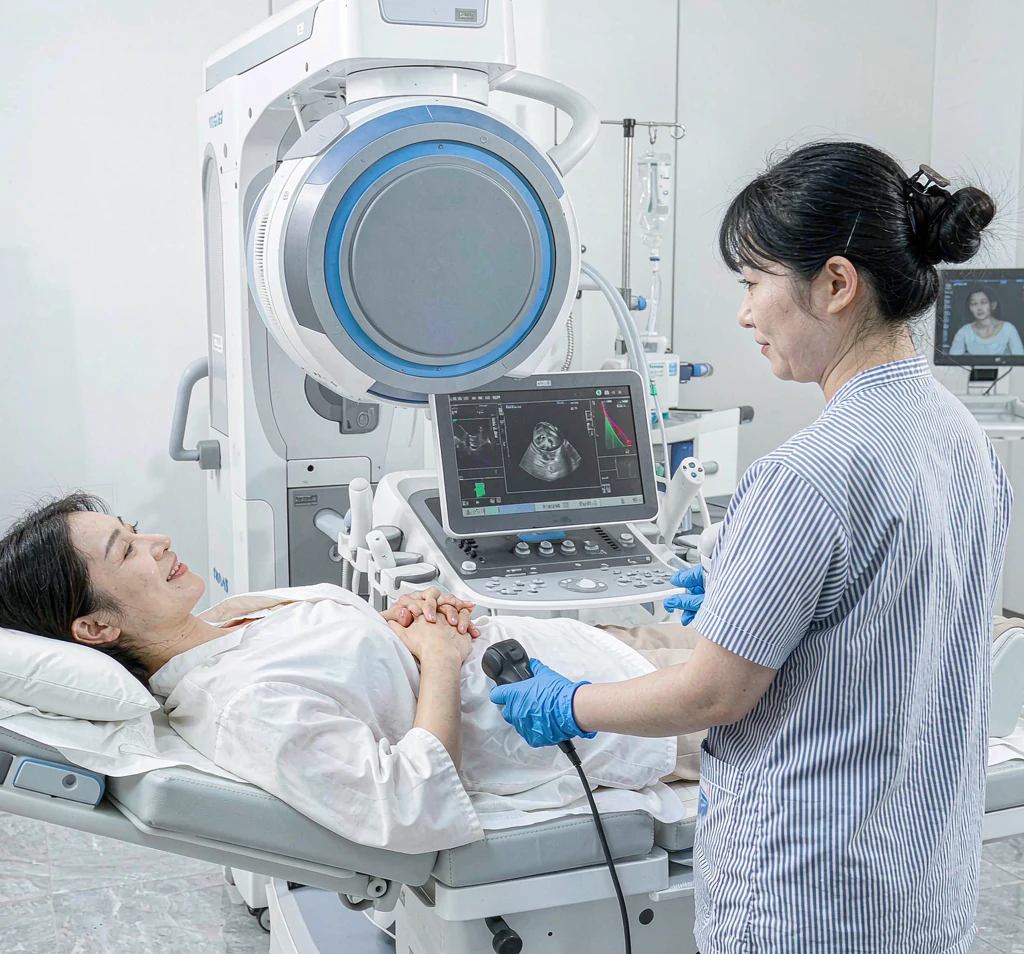
Haifu® UsgHIFU, also known as the "focused ultrasound scalpel," is short for "Ultrasound-guided High Intensity Focused Ultrasound Ablation." It is an innovative technology that destroys tumors inside the body without incisions, punctures or bleeding, and is sometimes described as "non-invasive surgery."
As a non-invasive treatment, Haifu® UsgHIFU works much like sunlight focused through a magnifying glass. It delivers dispersed ultrasound energy from outside the body, which safely passes through normal tissue and precisely converges on the target area inside the body. Using the inherent properties of ultrasound — the thermal effect and the cavitation effect — the focal region instantly reaches temperatures above 60°C, causing irreversible coagulative necrosis of the diseased tissue, while causing virtually no damage to the acoustic channel or the tissue outside the target area.
Haifu® UsgHIFU focuses low-energy extracorporeal ultrasound waves into a highly concentrated energy zone inside the body. Through the thermal effect and cavitation effect, it produces irreversible coagulative necrosis in the tissue within this focal zone, and the technology is widely used in tumor treatment.
In HIFU treatment, ablation is achieved when the tissue temperature is maintained at 60°C for more than 1 second, or under an equivalent thermal dose, causing protein denaturation and irreversible coagulative necrosis of the target tissue. Because of its high degree of focus, HIFU ablates only the target tissue without harming the surrounding normal tissue. Histopathology has shown that there is a sharp boundary of less than 50 µm — only 5-7 cell layers — between the coagulative necrosis zone and the surrounding area, demonstrating the remarkable precision and controllability of HIFU tissue ablation.
Cavitation is another key mechanical effect in HIFU thermal ablation in addition to the thermal effect. When ultrasound acts on a liquid medium, tiny gas nuclei in the liquid are activated, undergoing a series of oscillation, growth, compression and collapse processes known as acoustic cavitation, or simply cavitation. Cavitation causes bubbles to form at the focal point under high-intensity ultrasound; the collapse of these bubbles generates high-pressure shock waves (20-30,000 bars) and extremely high temperatures (2,000-5,000 K) within a microscopic region, damaging tissue in the immediate vicinity and further enhancing the ablative effect of HIFU.
Haifu® UsgHIFU has been used in clinical treatment for more than 20 years, holds more than 500 international intellectual property rights, and has been adopted in 30 countries and regions including China, the United Kingdom, Germany, Italy, Hong Kong, Singapore and South Korea, with over 240,000 accumulated treatment cases worldwide. The procedure has been incorporated into medical treatment guidelines such as the Guidance of The National Institute for Health and Care Excellence (NICE) in the UK, the Hong Kong College of Obstetricians and Gynaecologists OG Guideline, and the Chinese expert consensus documents "Chinese Expert Consensus on the Diagnosis and Treatment of Uterine Fibroids" and "Chinese Expert Consensus on the Diagnosis and Treatment of Uterine Adenomyosis."
Haifu® UsgHIFU focused ultrasound ablation is primarily used for the non-invasive treatment of benign gynecological tumors, and is also suitable for certain solid benign tumors in other locations.
Kind Reminder
Suitability for HIFU treatment must be comprehensively assessed by a specialist based on the size, location and number of tumors and the patient's overall health condition. Please contact us to arrange a pre-treatment assessment.
The following are typical application scenarios of Haifu® non-invasive treatment (case content to be supplemented; the following are illustrative descriptions).
For more clinical cases and treatment outcome data, please contact our professional team.
Enquire Now
To learn more about service details, fees or appointment arrangements, please contact our team of professional consultants and we will respond within one working day.
Phone: +852 3652 5702 | Email: info@globalhealthmanagement.com.hk
 Customer Service WeChat
 Enterprise WeChat
Please fill in the following details and our professional team will contact you as soon as possible to provide personalized health assessments and medical referral advice.
Customer Service WeChatEnterprise WeChat